
MV vs. LV Switchgear: What It Is and How It’s Used
“Switchgear” is one of those words people use loosely. This article breaks it down: what switchgear actually does, how medium-voltage and low-voltage equipment differ, what’s inside a typical lineup, and which standards govern it in North America.
What Switchgear Actually Does
Switchgear is the assembly of switches, fuses, circuit breakers, and protective relays that controls, protects, and isolates electrical equipment. It does three jobs:
- Switch — connect or disconnect circuits during normal operation or maintenance.
- Protect — automatically clear faults (short circuits, ground faults, overloads) before they damage equipment or hurt people.
- Isolate — provide a visible, lockable break in the circuit so workers can safely service downstream equipment.
Without switchgear, every utility outage would mean a substation reset, every motor fault could burn out a transformer, and every breaker change-out would be a major shutdown event.
Medium Voltage vs. Low Voltage — The Threshold
In North American practice, the cutoff between low and medium voltage is generally drawn at 1,000 V AC. Below that is “low voltage” (LV); above is “medium voltage” (MV) up to about 38 kV, beyond which “high voltage” begins.
The functional difference matters more than the number. At MV levels you’re dealing with much larger fault currents, much greater arc-flash energy, and air gaps and clearances that are an order of magnitude larger than at LV.
Low-Voltage Switchgear & Switchboards (≤ 1000 V)
This is the equipment that lives downstream of the building service transformer — the 480 V or 208 V distribution boards in an electrical room.
- Typically rated 480 V, 480Y/277 V, or 208Y/120 V.
- Uses insulated case or power air circuit breakers as main and feeder devices.
- Short-circuit ratings commonly 65–100 kAIC, occasionally 200 kAIC for large services.
- Built to UL 891 (switchboards) or UL 1558 (LV metal-enclosed switchgear).
- Front-accessible, with sections for the main breaker, feeder breakers, metering, and sometimes a tie breaker for double-ended designs.
Medium-Voltage Switchgear (1 kV – 38 kV)
This is the equipment between the utility service entrance and the building’s step-down transformers, or inside a generation, industrial, or substation environment.
- Typically rated 4.16 kV, 7.2 kV, 13.8 kV, 15 kV, 25 kV, or 35 kV class.
- Uses vacuum circuit breakers (overwhelmingly the modern choice — SF6 is being phased out for environmental reasons).
- Short-circuit ratings 25–63 kA symmetrical.
- Built to ANSI C37 / IEEE C37.20.2 (metal-clad) or IEEE C37.20.3 (metal-enclosed interrupter).
- Larger physical size — a 5 kV metal-clad cubicle is roughly 36″ wide × 96″ deep × 95″ tall.
- Strict compartmentalization (metal-clad construction): each function — bus, breaker, low-voltage controls, cable termination — is in its own grounded metal compartment.
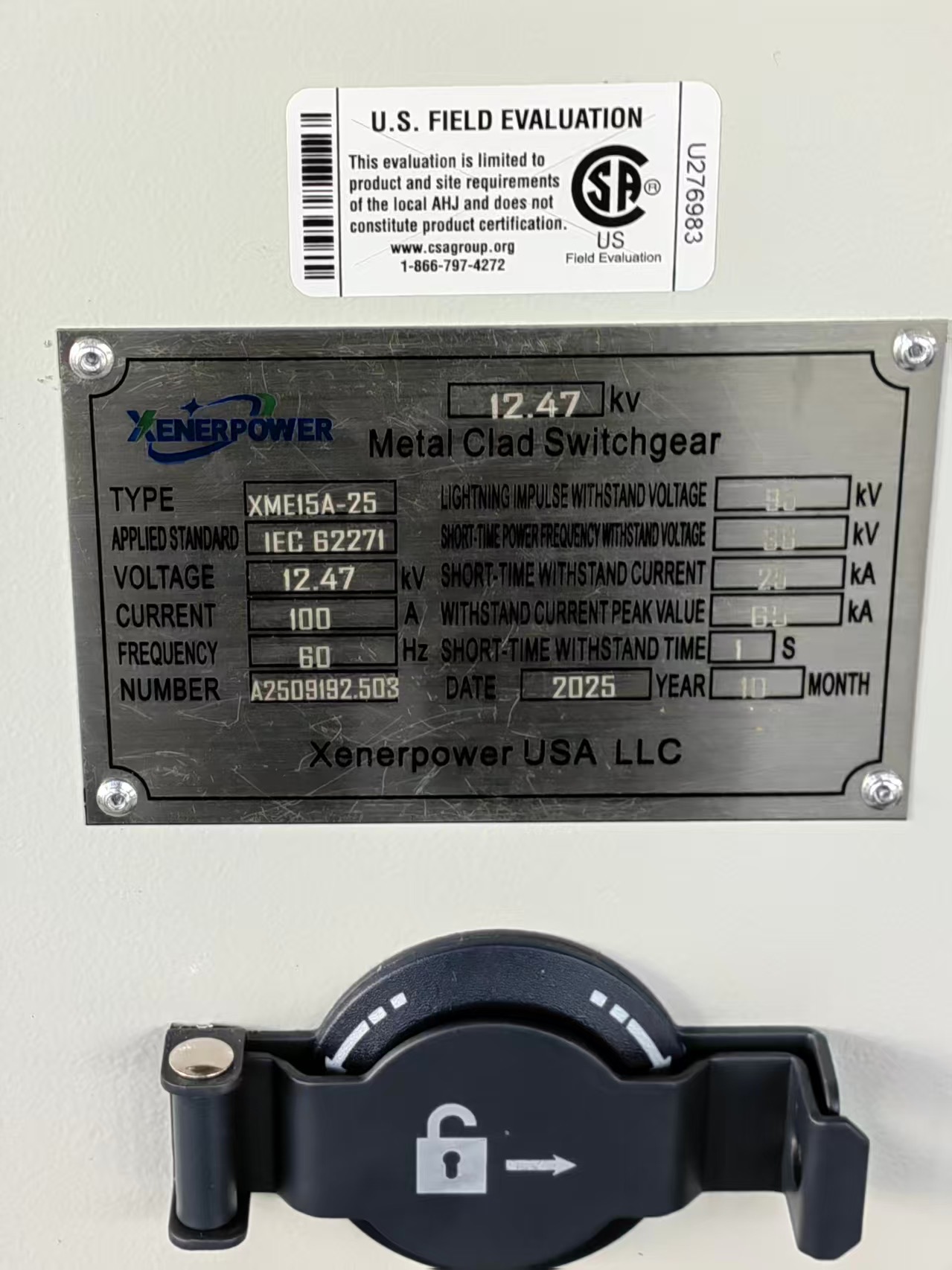
True metal-clad MV switchgear (per IEEE C37.20.2) means each compartment is isolated by grounded metal barriers. If a fault occurs in one compartment, the others are protected. This is the safest and most maintenance-friendly construction — and is what we recommend for any installation where personnel will work on the equipment energized.
What’s Inside a Typical MV Lineup
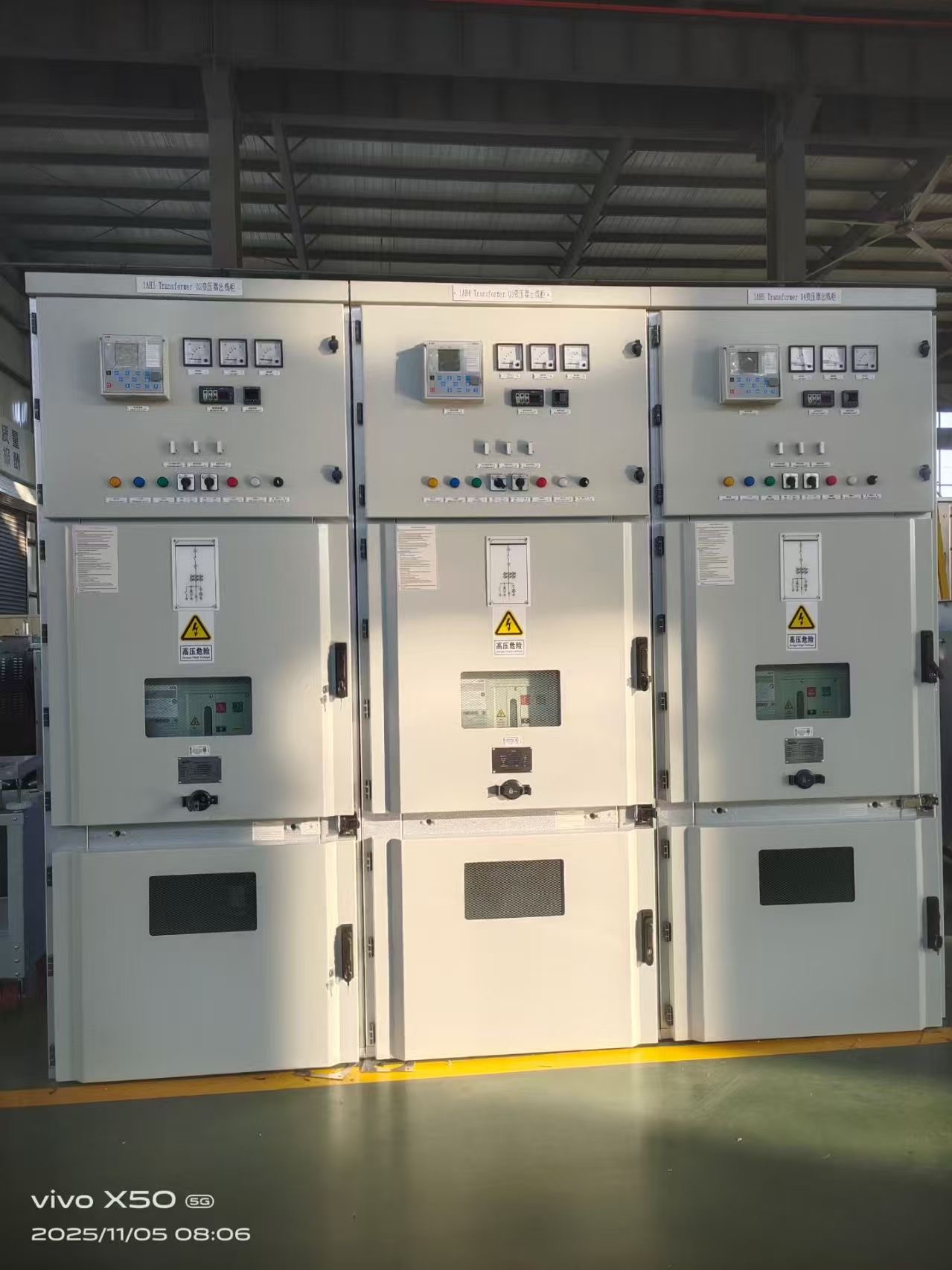
A modern metal-clad switchgear lineup contains, in each cell:
- Main bus compartment — copper or aluminum bars carrying the line voltage, supported on insulators.
- Breaker compartment — a draw-out vacuum circuit breaker on a racking mechanism. The breaker can be racked out to a “test” or “disconnected” position for safe maintenance.
- Cable / VT compartment — incoming or outgoing cable terminations, current and potential transformers (CTs and PTs) for metering and protection.
- Low-voltage compartment — protective relays, control switches, indicating lights, and terminal blocks. Increasingly this houses microprocessor relays (SEL, GE Multilin, ABB) doing all the protection logic.
Metal-Clad Cell Anatomy (IEEE C37.20.2)
Common Applications
Utility Substations
MV switchgear is the workhorse of distribution substations — accepting incoming feeders from a transmission step-down transformer and breaking them out to outgoing distribution feeders.
Industrial Plants
A typical refinery or large manufacturing site has a main MV switchgear lineup near the service entrance, with feeders to multiple unit substations spread across the plant.
Data Centers
Hyperscale and colocation data centers use MV switchgear at the utility tie, with redundant lineups (often a “main-tie-main” double-ended arrangement) feeding multiple step-down paths.
Renewable Energy
Solar and wind plants use MV switchgear at the project substation to combine collection feeders and tie to the utility transmission system.
Standards You’ll See on a Spec Sheet
Key Takeaways
- Switchgear switches, protects, and isolates — three distinct functions, all critical.
- The 1,000 V threshold separates LV from MV; the engineering, construction, and safety practices are very different above and below it.
- MV equipment is bigger, more compartmentalized, and built to ANSI C37; LV equipment is more compact and typically built to UL 891 or 1558.
- Modern protection is microprocessor-based — the days of electromechanical relays are largely behind us.
- Always design with arc-flash mitigation in mind — NFPA 70E compliance is non-negotiable.
We design and manufacture both LV switchboards (UL 891) and MV metal-clad switchgear (IEEE C37.20.2) at our Houston facility. Send us your single-line and we’ll spec it.
Building Out a Switchgear Lineup?
From single feeder breakers to full main-tie-main MV lineups — we can help.