
GRID INFRASTRUCTURE | FIELD REPORT
How a steel-and-copper box became the choke point for AI, clean energy, and the American grid — and what it takes to get ahead of it.
A Xenerpower field report · Houston, Texas · June 2026
Picture a fully permitted solar farm. The financing closed months ago. The panels are on site. The interconnection agreement is signed. And it sits there — earning nothing — because the one component that turns its output into grid-ready power is still on a factory floor, with a delivery date measured in years.
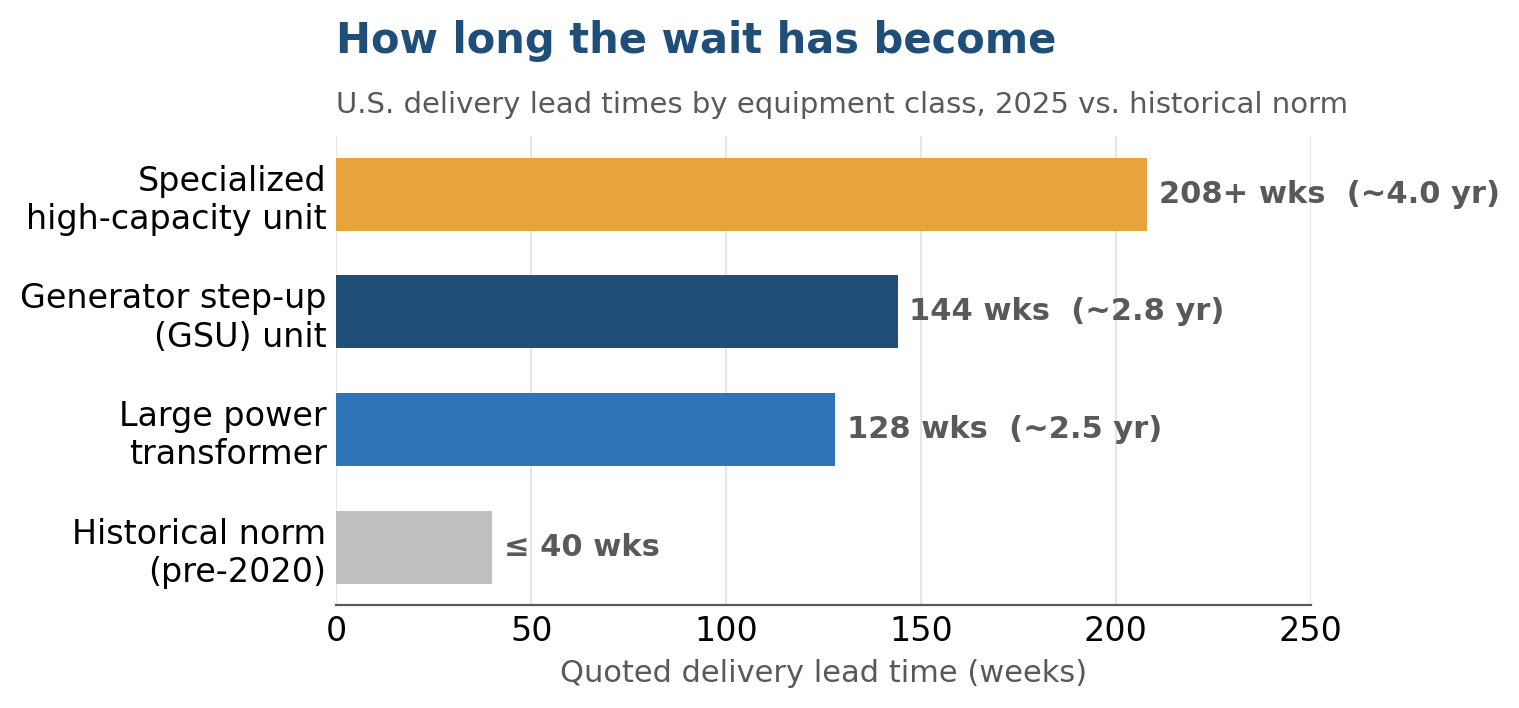
That scene is playing out across the country right now, and the culprit is not glamorous. It is the transformer — the unsung machine that steps voltage up and down so electricity can travel and be used. Today, a large power transformer takes about 128 weeks to deliver. That is two and a half years. For some specialized units, the wait stretches past four. Capital, permits, and generation are no longer the binding constraint on America’s energy buildout. Equipment is.
You can raise the money in a week. You can wait three years for the transformer.
The shortage, in five numbers
| Number | What it tells you |
|---|---|
| 128 wks | Average delivery time for a large power transformer in 2025 — up from well under a year before 2020. |
| ~80% | Share of U.S. large power transformers that are imported, exposing the grid to global supply and trade swings. |
| +100% | Rise in grain-oriented electrical steel (the core material) prices since January 2020. Copper is up ~50%. |
| 30% | Modeled 2025 supply shortfall for power transformers across the U.S. fleet (10% for distribution units). |
| ~40 yrs | Average age of the installed U.S. large-transformer fleet — at or past its design life, so replacement demand never stops. |
Sources: Wood Mackenzie (2025); U.S. Department of Energy; POWER Magazine; LBNL. See references.
Why this isn’t a part you can just reorder
A transformer is not a catalog item. It is built to order from grain-oriented electrical steel, tons of copper winding, and specialized insulation, then assembled and high-voltage tested by skilled hands. There is no warehouse of spares. When demand jumps, the queue simply gets longer — and over the past few years, it has gotten dramatically longer across every class of equipment.
Three demand waves, one factory floor
What changed is not one trend but a collision of several, all pulling on the same limited manufacturing base at once.
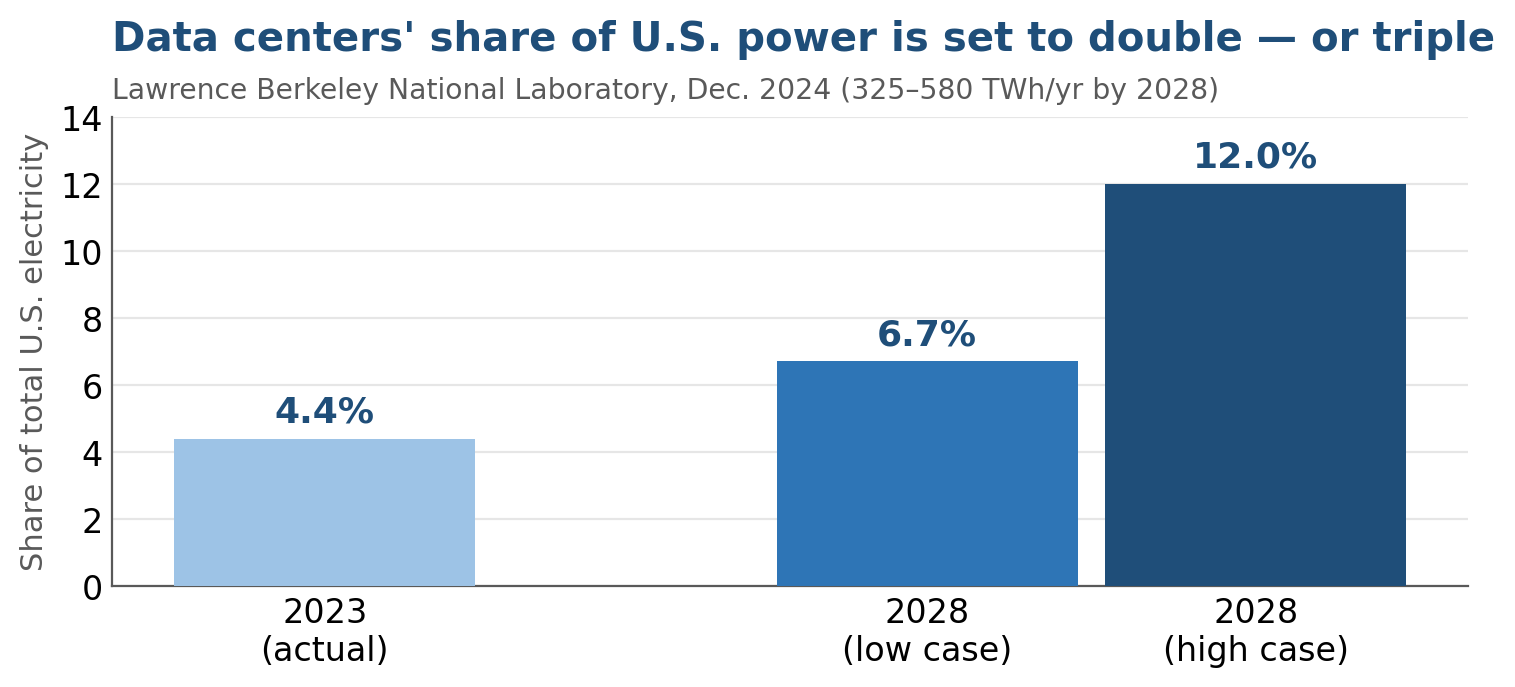
- Artificial intelligence. Data centers used about 4.4% of U.S. electricity in 2023; Lawrence Berkeley National Laboratory projects 6.7%–12% by 2028 — 325 to 580 terawatt-hours a year. Each AI campus needs hundreds of megawatts and a stack of transformers to deliver it.
- Clean energy. Record solar and storage additions each require pad-mount transformers to gather inverter output and step-up units to reach transmission voltage.
- An aging grid. More than half of U.S. distribution transformers — on the order of 40 million units — are already past their expected service life and must be replaced regardless of new construction.
The macro forecast captures the shock: in its 2025 Long-Term Reliability Assessment, NERC raised its ten-year summer peak-demand growth projection to 224 GW — 69% higher than just a year earlier, the steepest growth rates it has recorded since 1995, driven mostly by data centers.
Why supply can’t simply catch up
If demand is the accelerator, the supply side is a brake that can’t be released quickly. The inputs are scarce and the skills are slow to build.
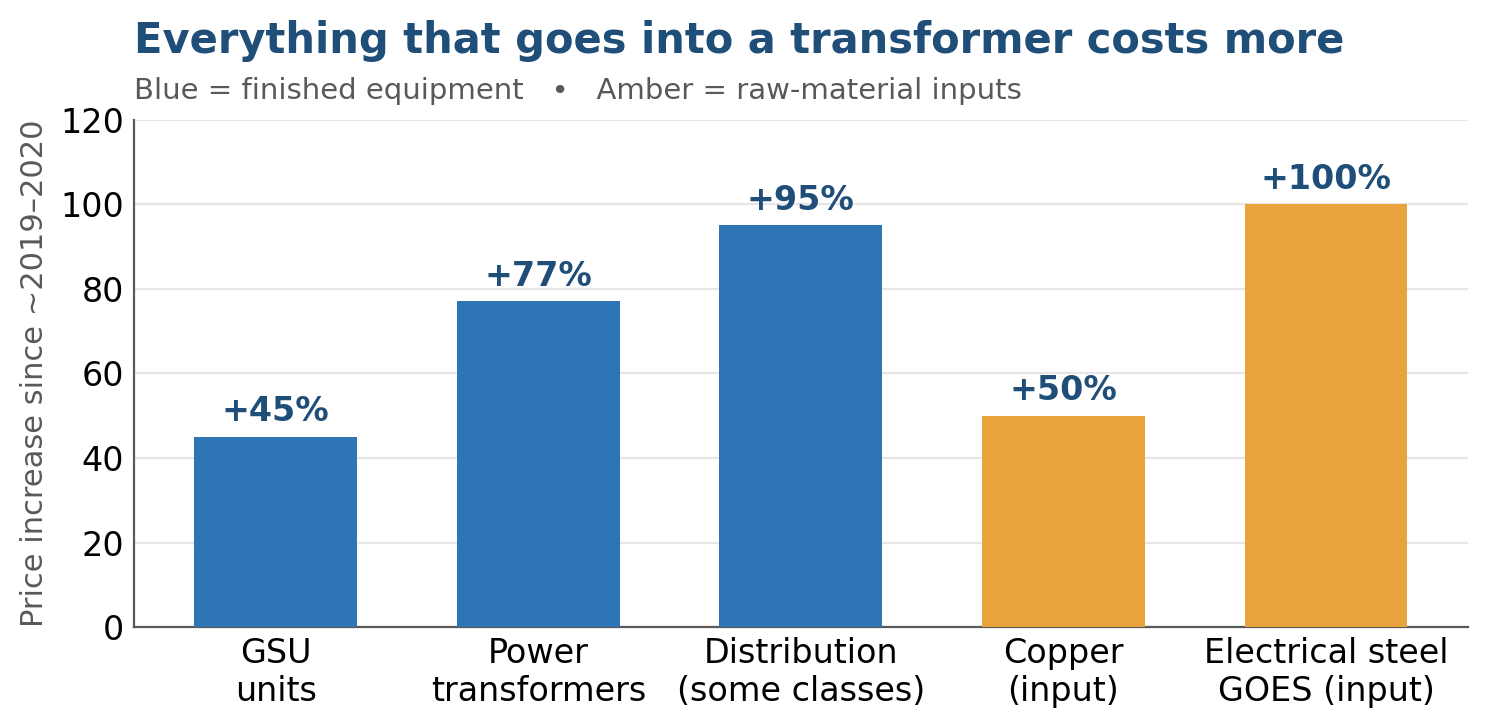
Grain-oriented electrical steel — the specialized core material — has roughly doubled in price since 2020, and U.S. mills supply only about a fifth of national demand. Copper is up more than 50%, with new tariffs of up to 50% adding pressure. Roughly 80% of large power transformers are imported. And winding and testing require expertise that takes years to develop. You cannot answer a demand surge by opening a plant next quarter; a transformer factory takes years to build and qualify.
The squeeze is systemic — and it plays favorites
This is bigger than transformers. Demand across nearly every category of transmission-and-distribution gear has surged 35% to 274% since 2019: generator step-up demand is up 274%, substation power transformers 116%, with medium-voltage switchgear and breaker prices up roughly 50% and 47%. Securing one component no longer guarantees the rest.
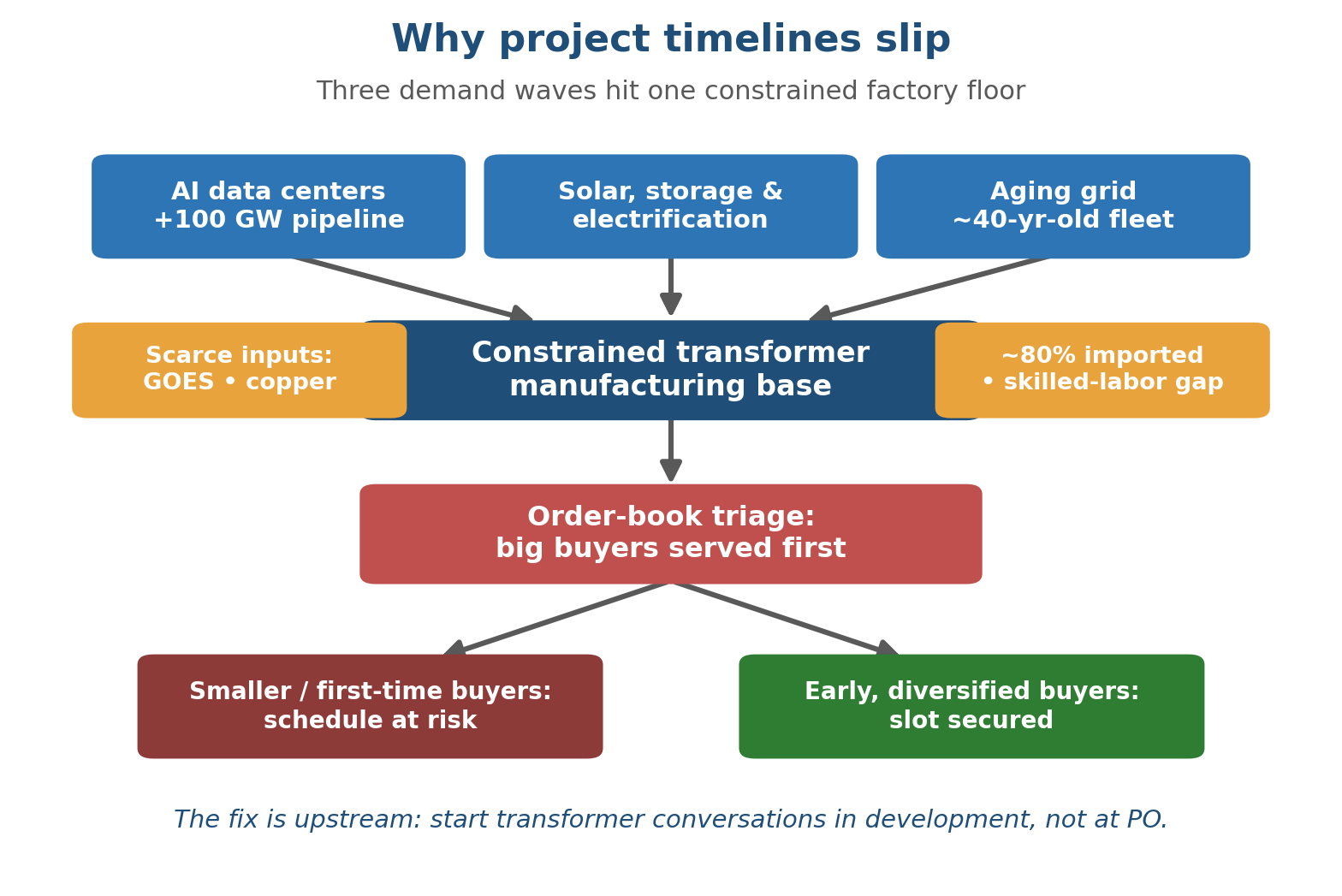
And scarcity creates a pecking order. Manufacturers with full order books serve their largest, longest-standing customers first. The diagram below shows how the squeeze flows through to the projects that slip — and the ones that don’t.
Demand growth since 2019, by equipment
| Equipment / input | Change since 2019 | Metric |
|---|---|---|
| Generator step-up (GSU) units | +274% | Demand |
| Substation power transformers | +116% | Demand |
| Medium-voltage switchgear | +50% | Price |
| Circuit breakers | +47% | Price |
| Distribution transformers (some classes) | +95% | Price |
| Grain-oriented electrical steel | ~+100% | Price |
Source: Wood Mackenzie & American Clean Power, “Making the Connection,” September 2025.
Relief is coming — just not on your schedule
There is real good news. Since 2023, manufacturers have committed nearly $2 billion to new and expanded North American transformer capacity — Hitachi Energy’s $457 million Virginia plant (slated to be the country’s largest), Siemens Energy’s first U.S. large-transformer factory in Charlotte, Eaton’s $340 million South Carolina facility, and expansions from Prolec GE, Virginia Transformer, WEG, and others. But new plants take years to commission and qualify, and analysts still expect deficits to persist — with the pad-mount shortage possibly worsening as data-center and EV-charging demand climbs. Relief is on the way; it just won’t rescue a project that started its transformer conversation too late.
How to stay ahead of the curve
The constraint is real, but it responds to planning. Three moves consistently separate the projects that hold their schedule from the ones that slip.
| # | Move | Why it works |
|---|---|---|
| 1 | Start in development, not at PO | Engage manufacturers when site control is set and interconnection is being studied. Early talks unlock preliminary pricing, lead-time guidance, and slot reservations. |
| 2 | Diversify your suppliers | The market for UL-listed, code-compliant units is broader than most teams assume — including suppliers with U.S. inventory and ready-to-ship stock for urgent needs. Build those relationships before a crisis. |
| 3 | Track equipment like a grid metric | Generation, congestion, and queues are tracked closely; equipment supply isn’t. Treating transformer lead time as a monitored indicator enables proactive, not reactive, responses. |
The bottom line
None of this is an argument against the buildout. The scale of investment and the ambition behind it are extraordinary and worth the effort. It is an argument for taking the buildout seriously enough to plan for the equipment it actually requires. Over the next five years, the projects that energize on time will be the ones whose teams understood the full supply chain their ambition depends on — not just the visible parts, but the foundational machine that makes every new megawatt deliverable to the grid.
Transformers are that machine. It’s time the planning caught up to the wait.
About Xenerpower
Xenerpower is a Houston, Texas–based manufacturer and service provider of transformers, switchgear, and switchboards with more than 30 years of industry expertise. The company designs, manufactures, distributes, and services UL-listed power equipment for urban grids, industrial facilities, data centers, and renewable-energy installations across North America — with end-to-end capability spanning installation, upgrades, refurbishment, repair, rental, and proactive maintenance.
References
- POWER Magazine, “Transformers in 2026: Shortage, Scramble, or Self-Inflicted Crisis?” (Jan. 2, 2026), summarizing Wood Mackenzie supply-chain data.
- pv magazine USA, “U.S. transformer market faces severe supply constraints as lead times extend to four years” (May 11, 2026).
- Lawrence Berkeley National Laboratory, “2024 United States Data Center Energy Usage Report” (Dec. 2024).
- NERC, “2025 Long-Term Reliability Assessment”; reporting via Utility Dive.
- Wood Mackenzie & American Clean Power, “Making the Connection: Meeting the Electric T&D Supply Chain Challenge” (Sept. 2025).
- U.S. Department of Energy, “Large Power Transformer Resilience Report to Congress” (2024) — import reliance and fleet age.
- IndustrialSage, “Power Transformer Lead Times Hit Record Highs as U.S. Grid Equipment Shortage Deepens.”
Figures reflect the most recent publicly available industry analyses as of June 2026 and vary by voltage class, specification, and supplier. Confirm current quotes with manufacturers for project-specific planning.